
Handyman Services in Smithfield, Utah
S&C Handyman Services works on homes in Smithfield, Utah, the Cache Valley city that grew from a fort on Summit Creek into the valley's second-largest community. Seth and Collin own the business and do the work: fence and deck repair, concrete pads, doors, flooring, bathrooms and fixture swaps. Every quote is free, and you know the full price before work starts. Call or text Seth at (385) 615-5295 or Collin at (208) 240-0698.
Call or text: Seth (385) 615-5295 Text Collin (208) 240-0698 Text
How a fort on Summit Creek became Cache Valley's second-largest city
Smithfield's first settlers came in 1859 and built cabins from the cottonwoods along Summit Creek. The settlement was first called Summit. In July 1860 the families built a fort with the creek running through it, and that year the town took the name Smithfield City after its first bishop, John G. Smith. In 1864 the fort came down and families moved onto surveyed one-acre lots.
The narrow-gauge Utah Northern Railway reached town in 1873. The next century brought a Del Monte vegetable cannery, a Carnegie library and a high school, and most farmland inside the city has since become neighborhoods. The city's 2026 general plan counts 14,033 residents in 2023, up from 10,832 in 2017, and 4,200 homes, up from 3,196.
A new house on the edge of town needs a fence and a pad for the shed. An older house in the original town site more often needs its doors, porch steps and trim brought back.
What Smithfield's mix of 1970s houses and new builds means for repairs
Census estimates for 2020 to 2024 put the median year built for a Smithfield home at 2002, and about 34 percent of homes went up in 2010 or later. The 1970s left a bigger mark here than in North Logan or Hyde Park: 13 percent of Smithfield's homes date from that decade, and about 7 percent were built before 1940.
A house from the 1970s is now about fifty years old. Interior doors drag on worn hinges, bathroom grout and tile crack, and the original sheet vinyl or carpet is ready to come up. Those are jobs for door repair, bathroom and tile work and new plank floors.
Newer houses need different things. About 81 percent of Smithfield homes are detached houses and about 80 percent are lived in by their owners, so most work is on houses people plan to keep: a fence around a bare backyard, a pad for a shed or hot tub, a deck stained before a few winters turn it gray.
Smithfield's fence rules, from the front yard to Main Street
Smithfield's zoning code caps fences, walls and hedges at 6 feet in any front, side or rear yard. In the R-1 single-family and RM multiple-family zones, a front-yard fence can be no taller than 4 feet. Commercial lots along Main Street (State Road 91) and 100 North (State Road 218) are held to 4 feet in their front and side setbacks.
Where the ground is higher on one side, height is measured from the average of the finished grades on both sides at the fence line. On top of a retaining wall that holds back fill, the wall counts toward the fence height, though a protective fence up to 48 inches is always allowed along the top.
The city's building permit section exempts fences 6 feet tall or less, and retaining walls up to 4 feet measured from the bottom of the footing unless they hold back extra load. So a standard backyard cedar fence usually needs no building permit here, but it still has to meet the height limits. Blue Stakes of Utah asks for notice at least three business days before any digging, and the locate request is free.
Decks, sheds and who issues the building permit in Smithfield
Smithfield contracts with the Cache County Building Department to issue its building permits. The city signs off first with a zoning clearance, and the county won't issue a permit until that clearance is approved. The county office is at 179 North Main Street in Logan; the city office is at 96 South Main.
In the R-1 zone, a shed or detached garage set at least 10 feet behind the house may sit 5 feet from the side and rear lot lines. It can't be taller than the house and never more than 20 feet, and all accessory buildings together may cover no more than 25 percent of the rear yard.
Decks have a rule worth knowing. An unroofed deck on posts may reach up to 12 feet into the 30-foot rear setback, but only if it sits less than 30 inches above the ground or more than 84 inches up. A deck in between gets no such allowance, so check the setback before you extend one.
Benches, clay and the East Cache fault: why posts and slabs move in Smithfield
The older part of Smithfield slopes about 3 percent, from 4,880 feet on the east side to 4,500 feet on the west. East of town, the benches along Lake Bonneville's old shoreline approach a 30 percent slope, and slopes in the Canyon Road area run from 20 to 80 percent. The general plan says the East Cache Fault Zone runs along the base of the eastern foothills, and that earthquakes in the region have caused structural damage inside city limits.
Soil changes across town. Silty gravel is most common, but the far north end is silt-clay and clay, and a perched water table under the east bench feeds springs. On the west and southwest side, groundwater sits only a few feet down. Wet clay heaves when it freezes, which is a common reason a fence post leans or a gate stops latching after winter.
The plan gives a temperature range of 100 to minus 30 degrees, with more than half of the 16.6 inches of yearly precipitation falling as snow, and spring melt can flood along Summit Creek and Birch Creek. For a concrete pad, that means a compacted gravel base, control joints and a pour after the ground thaws. For fence and pergola posts, it means concrete footings set below the frost line.
What to do first when something needs fixing at a Smithfield house
These steps make the quote faster and more accurate.
- Text a photo to Seth or Collin with a line about what changed and when you first noticed it.
- For a leaning fence, note which posts move and whether the ground there stays wet in spring.
- For a door that sticks, check for loose hinge screws before anyone planes the edge; a planed door can't be put back.
- For a new shed, deck or pad, ask the city about zoning clearance before materials are bought.
- Find your lot lines and any easements on the plat before a fence or slab is laid out.
Jobs Smithfield homeowners call us for
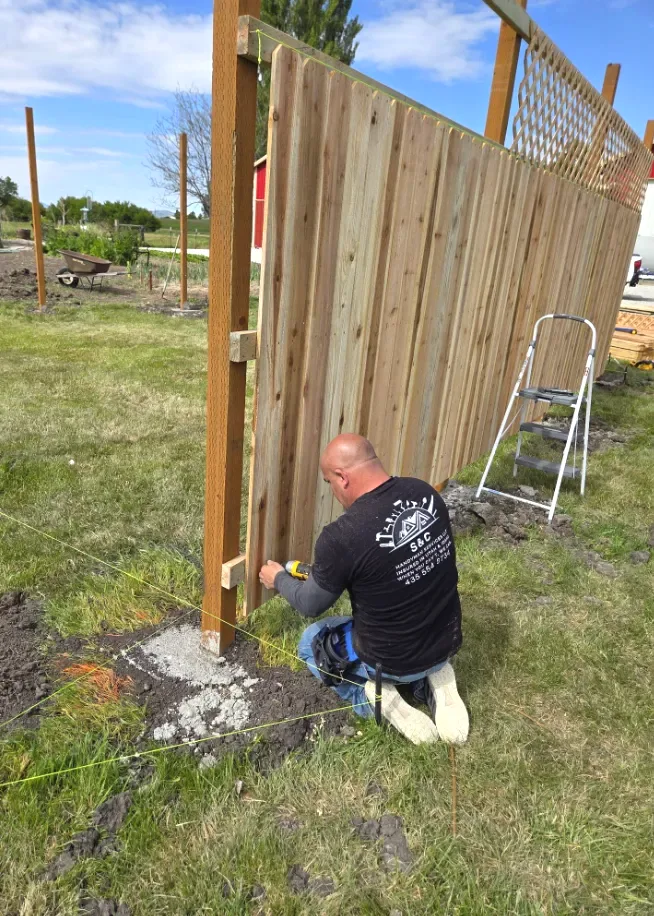
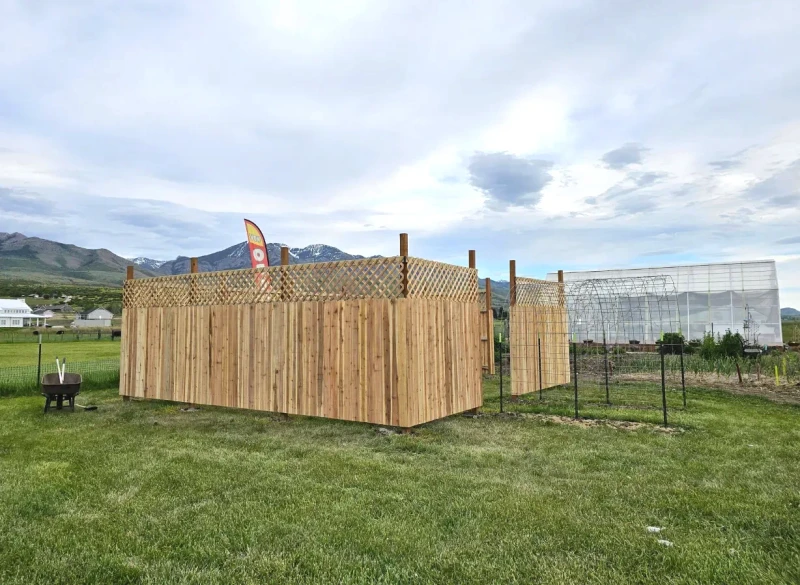
- Fence Repair →
Smithfield caps fences at 6 feet, and 4 feet in R-1 front yards, so new and repaired fences are built to those heights from the start.
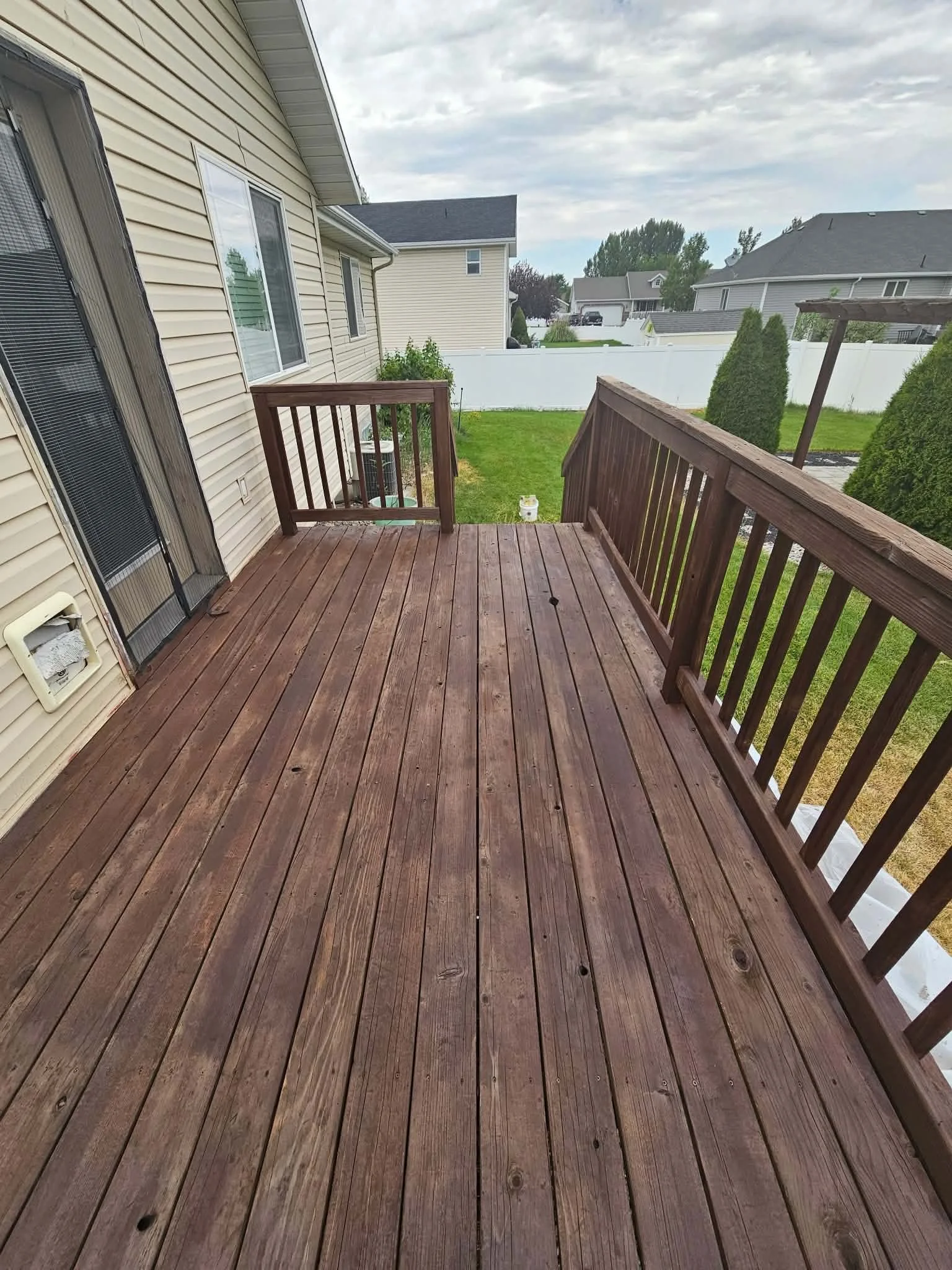
- Deck Repair & Staining →
Decks on the newer houses gray out after a few snowy winters; washing, sanding and stain keep the boards sealed before the next one.
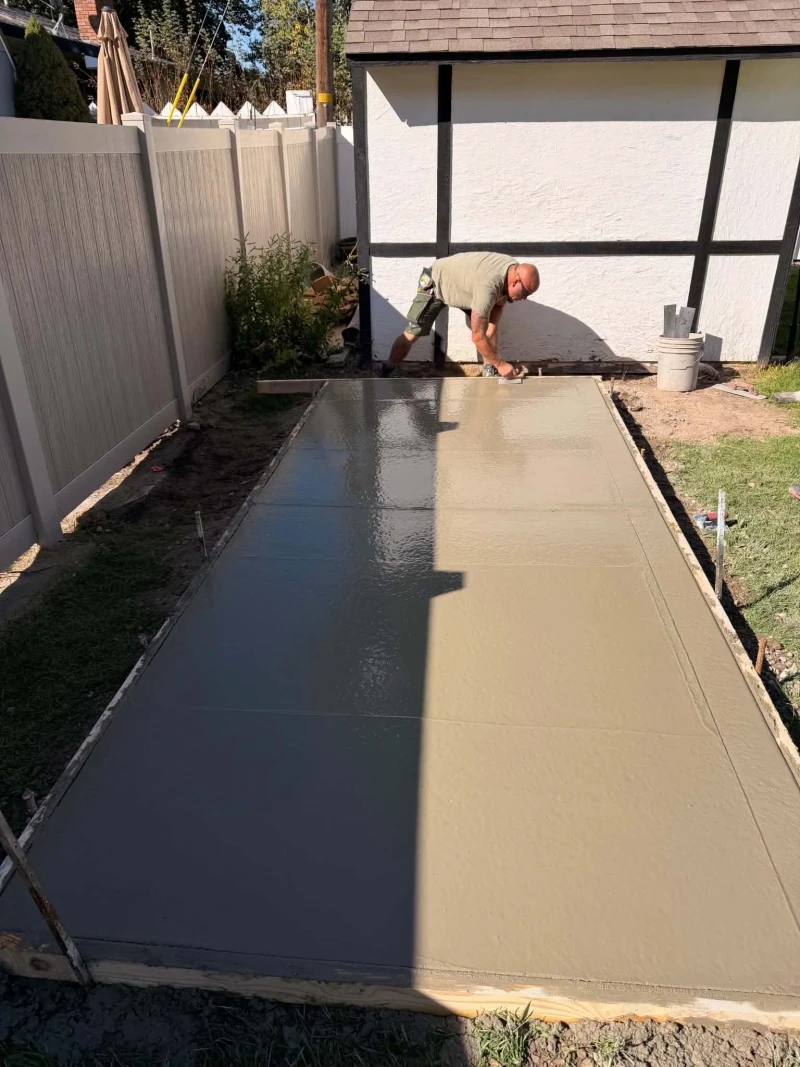
- Concrete Pads →
Shed and hot tub pads need a compacted gravel base here, where clay and shallow groundwater in parts of town shift with the frost.
- Door Repair →
Doors in Smithfield's 1970s houses are about fifty years old, and worn hinges and shifting frames make them drag or stop latching.
- Bathroom Remodels & Tile →
Bathrooms in the town's 1970s and older homes often need cracked tile and failed grout replaced, or a full tear-out to the subfloor.
- Flooring & LVP →
Rentals grew from about 12 to 20 percent of Smithfield homes between 2017 and 2023, and turnover is when old carpet comes up and plank goes down.
- Pergolas & Patio Covers →
Shade over a bare back patio is a common add in the newer subdivisions; we check setbacks and the city's clearance before anything is built.
- Pressure Washing →
Spring melt and wet ground leave mud and green growth on north-side fences and patios, and a late-spring wash readies them for stain.
A few of our recent projects
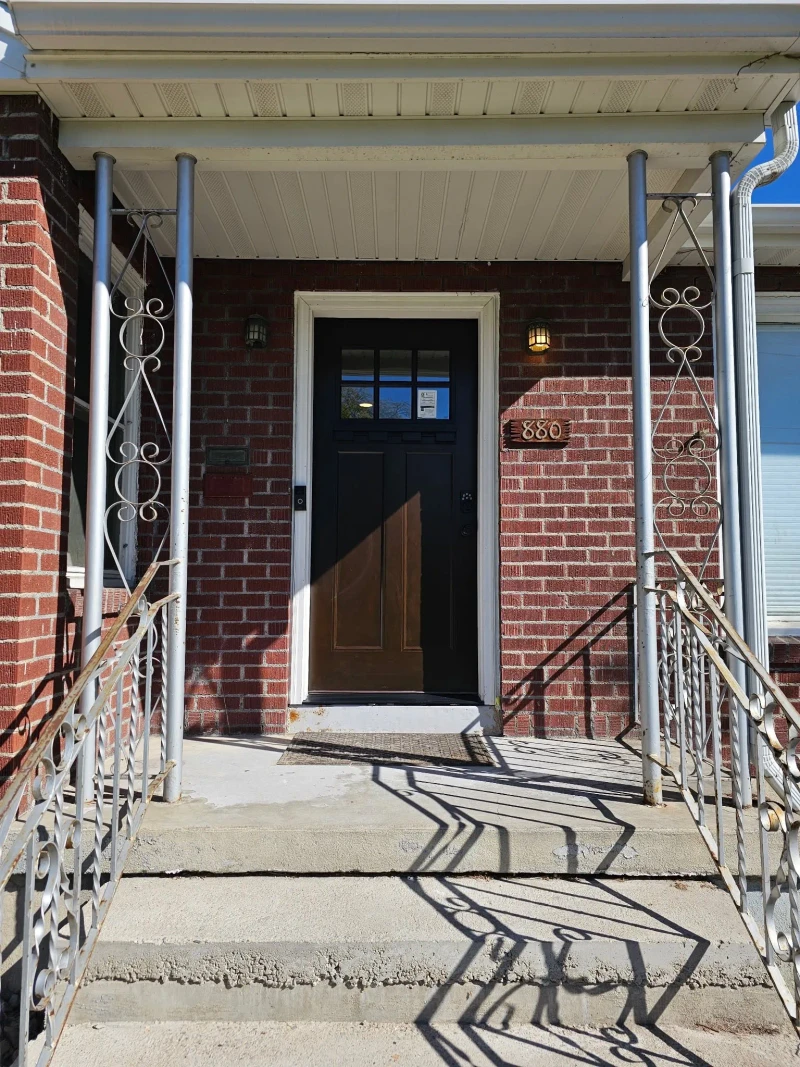
Seth and Collin's own job photos, from the project gallery.
“S&C Handyman Services showed up on time, had clear and what I thought was fair pricing, they were honest and got the work done when they said they would!”
Coming to Smithfield from Logan
S&C Handyman Services is a handyman in Logan, Utah. The outline on the map is the area we cover across Cache Valley and Southeast Idaho. Nearby, we also work in Hyde Park , Richmond and North Logan . See every town we serve.
Smithfield questions
Do I need a permit for a fence in Smithfield?
Not a building permit, as long as the fence is 6 feet tall or less. It still has to meet the zoning heights: 6 feet at most anywhere on the lot, and 4 feet in the front yard in the R-1 and RM zones.
Who issues building permits for a deck or shed in Smithfield?
The Cache County Building Department, after the city approves a zoning clearance. A small one-story shed within the size the building code exempts needs no building permit, but it still has to meet the setbacks and stay within 25 percent of the rear yard.
Why does my fence lean after every winter?
Usually water and frost at the post. Wet clay heaves as it freezes and thaws, and a post set shallow or without concrete gets pushed a little each year. A new post on a deeper concrete footing often fixes it; a whole new fence is only needed when most posts have rotted at the ground line.
Can you work on a steep lot on the east bench?
Yes. Steep lots take more planning for footings, drainage and getting materials to the work area, and that planning goes into the quote.
How is a handyman job in Smithfield priced?
Each job is quoted on its own, for free. On a Smithfield job the main drivers are size, materials, how much old work comes out, a steep or wet site, and whether a city zoning clearance and a county permit are needed. You get the full price before any work starts.
What days do you work in Smithfield?
Monday to Thursday, 8 am to 5 pm. Text a photo of the job any time, and Seth or Collin will reply during work hours to set up a free quote.
Where these facts come from
- Smithfield City General Plan Update 2026 (adopted): history, growth since 2017, climate, slopes, soils, groundwater and the East Cache Fault Zone (Smithfield City)
- SMC 17.12.080, Wall, fence or hedge (Smithfield Municipal Code)
- SMC 17.40.010, Building permit required: exempt fences, retaining walls and sheds (Smithfield Municipal Code)
- SMC 17.56, R-1 single-family residential zone: accessory building setbacks and height, deck projections (Smithfield Municipal Code)
- SMC 17.12.090, Area of accessory buildings (Smithfield Municipal Code)
- Building Inspection Resources: Cache County issues Smithfield's building permits after a city zoning clearance (Smithfield City)
- Year structure built, Smithfield, North Logan and Hyde Park, ACS 2020 to 2024 5-year estimates, tables B25034 and B25035 (US Census Bureau, via Census Reporter)
- Units in structure and tenure, Smithfield, ACS 2020 to 2024 5-year estimates, tables B25024 and B25003 (US Census Bureau, via Census Reporter)
- Smithfield, UT profile, ACS 2024 5-year (Census Reporter)
- Notify Blue Stakes of Utah 811 at least 3 business days before excavation (Blue Stakes of Utah)
Let’s Get Your Project Done
Tell us what you need and we’ll get back to you with a free, no-obligation quote. Prefer to talk? Call or text (385) 615-5295.
Availability
Monday–Thursday, 7:00 AM–5:00 PM. Call or text any time during business hours and we’ll set up a visit that fits your schedule. We respond fast.
Thanks, we got it!
We’ll get back to you shortly with your free, no-obligation quote. Need us sooner? Call or text (385) 615-5295.